Inside Avebury Henge: Every Circle, Avenue and Standing Stone Explained
The short answer
Avebury is three monuments inside one earthwork: a bank and ditch 347 metres across, an outer circle of about a hundred sarsens, and two smaller circles within that. Two roads quarter it, a village sits in the middle, and roughly half of what stands today was put back up in the 1930s.
Start with the earthwork, not the stones
The henge is the bank and the ditch. Everything else sits inside it. The bank encloses a circle about 347 metres in diameter and more than a kilometre round, and inside the bank runs a ditch that was cut some eleven metres down into solid chalk and left about four metres wide at the base.
That was dug with antler picks. Harold St George Gray's excavations between 1908 and 1922 pulled more than forty of them off the ditch floor. Standing on the bank crest and looking down was originally a drop of around twenty metres, and walking the bank rather than the field is still the only way to feel the scale.
The four quadrants, and which to walk first
The A4361 runs north to south through the henge and the Swindon–Devizes road crosses it, so the interior comes in four unequal pieces. They are not equally rewarding.
| Quadrant | What is in it | Walk it if |
|---|---|---|
| South-west | The Barber Surgeon Stone and the longest restored arc of the outer circle | You have one hour. Start here. |
| North-east | The northern inner circle and the two surviving Cove stones | You want the biggest stones on the site |
| South-east | The site of the southern inner circle and the Obelisk; the Avenue leaves here | You are walking out along West Kennet Avenue |
| North-west | The clearest surviving bank and the fewest people | You want the earthwork, and quiet |
The outer circle
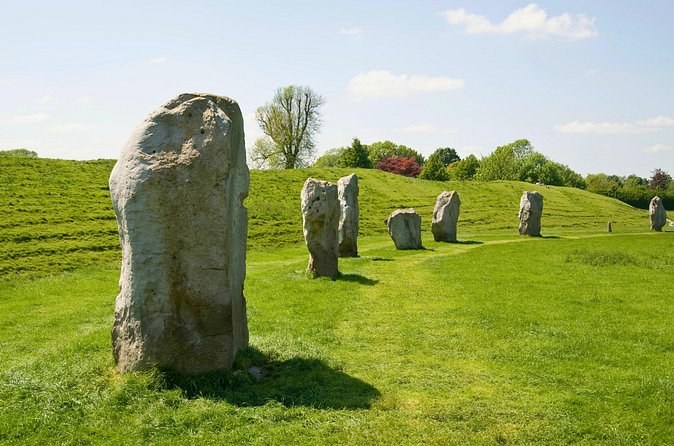
Just inside the ditch stands the outer circle: the largest stone circle in Britain, originally around a hundred sarsens on a ring some 331 metres across. The stones run between 3.6 and 4.2 metres tall, and the heaviest are over forty tons.
What they are not is worked. Nobody dressed, squared or jointed them, and there are no lintels. Sarsen is a hard silicified sandstone that lay scattered across these downs, and the builders raised the blocks broadly as they found them. That is the plainest difference from Stonehenge, and it is visible in every photograph on the gallery.
The northern inner circle and the Cove
Inside the outer ring sit two smaller circles, and this is where visitors most often walk straight past a monument without registering it. The northern circle is about 98 metres across and only a couple of its stones still stand.
At its centre stood the Cove: three vast stones in a three-sided box, open to the north-east. Two survive. Standing between them is the closest thing Avebury has to an interior, and they are among the largest stones on the whole site.
The southern inner circle and the Obelisk
The southern circle measured about 108 metres before the eighteenth-century destruction took most of it. At its centre stood a single monolith about 5.5 metres high, recorded by William Stukeley and known ever since as the Obelisk.
It no longer exists. Its position is marked in the turf, which is the first hint of the pattern that runs through the whole place: a great deal of what you are looking at is a marker for something that is not there.
The Barber Surgeon Stone
In 1938 Alexander Keiller's team lifted a fallen stone in the south-west quadrant and found a skeleton under it, with iron scissors, a lancet and coins dated 1320–25. The reading is straightforward: a man helping to topple and bury the stone was caught when it came down.
The tools suggested a barber-surgeon and the stone has carried the name since. It stands re-erected today, and it is the one stone at Avebury with a story most visitors will remember a year later. The wider destruction it belongs to is on the history of Avebury.
The concrete markers, and what they mean
Low concrete plinths sit in the turf all round the circle. They are not stones and they are not ancient. Keiller's excavators set one wherever they found the socket of a stone that had been destroyed or buried, so the plan could be read again.
This is the single most useful thing to know at Avebury, and no interpretation board states it plainly. Once you have it, the site reorganises itself: the complete-looking arcs are a 1930s reconstruction, the gaps are real losses, and the concrete is an honest record of both. It is also the first thing a guide tells you on an Avebury guided tour, and the reason people rate them.
West Kennet Avenue and Beckhampton Avenue
From the south-eastern entrance, West Kennet Avenue runs in pairs of stones for about two and a half kilometres towards The Sanctuary on Overton Hill. Keiller excavated and part-restored the northern stretch in 1934 and 1935. Walking out along it takes twenty minutes, costs nothing, and almost nobody on a coach day does it.
A second avenue ran west towards Beckhampton. Stukeley recorded it in the 1720s and was disbelieved for the best part of three centuries, until excavation in the 1990s proved him right. Two stones survive above ground, known as the Longstones, and there is no restored walk to follow — this one is a matter of knowing what the field held.
Both avenues point at something. West Kennet Avenue runs to The Sanctuary on Overton Hill, where timber and stone settings are now marked out with concrete posts of the same kind used inside the henge. Whatever Avebury was, it was not a single enclosure: it was the centre of a landscape that reached at least two and a half kilometres in each direction.
A walking order that works
- From the car park, go up onto the bank and turn clockwise.
- South-west quadrant: the Barber Surgeon Stone and the restored arc.
- Cross into the north-west for the bank at its clearest, and the quiet.
- North-east: the northern inner circle and the Cove.
- Down into the village for the museum, then out through the south-east entrance.
- Along West Kennet Avenue as far as you have the appetite for.
That is about ninety minutes at a steady pace, which is why the hours-at-Avebury column matters so much when you are choosing a tour. A route map and the distances to the outlying monuments are on the Avebury map page, and what to expect underfoot is on the visiting page.
If you are arriving under your own steam, getting to Avebury covers the bus and the car park, and the FAQs answer what you can and cannot do once you are inside. If somebody else is driving, Avebury Tours sets out how long each day actually stops here — and you will want that number, because ninety minutes and thirty minutes are different visits.
Want someone to point out which stones are Keiller's? That is the difference a guide makes here, and it is not in any leaflet. See which Avebury tours give you long enough to walk all four quadrants, or read how to choose between them.
Guided days with time to walk the whole circle
Full-Day Stonehenge and Avebury Tour from Glastonbury
Four hours at the stones, the longest stay of any guided departure.
From $213 per person
Check AvailabilityStonehenge and The Stone Circles of Avebury Day Trip from London
Two hours in the circle plus a chambered tomb you can walk into.
From $134 per person
Check AvailabilityBespoke private tours of Stonehenge and Avebury by car with local guide
A private guide who will tell you which stones went back up in 1938.
From $509 per group, up to 6
Check Availability