14 Facts About Avebury That Will Surprise You
The short answer
Avebury was dug out of chalk with antler picks, dismantled with fire and sledgehammers, bought back with a marmalade fortune and partly rebuilt in the 1930s. It has a pub, two main roads and part of a village inside it, and it is free to walk into.
Avebury is the stone circle most British people have heard of second and almost nobody can describe. It is larger than Stonehenge, older in parts, free to walk into, and its story runs from antler picks to a marmalade fortune. Here are the fourteen things visitors are most often surprised by, every one of them from the National Trust, English Heritage or the published excavation record.
1. It is bigger than Stonehenge by an order of magnitude
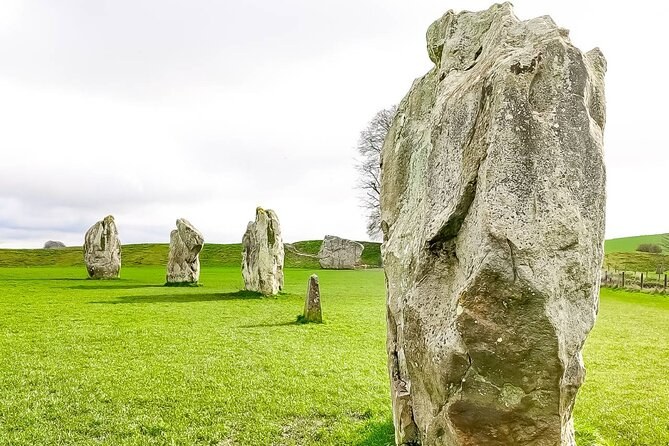
The henge is about 347 metres across and more than a kilometre round. Stonehenge's stone setting is roughly thirty metres. You can stand in the middle of Avebury and not be able to see the far side of the bank, which is not a sentence anyone has ever written about its famous neighbour.
The outer circle alone held around a hundred sarsens on a ring 331 metres wide, the tallest over four metres. Two smaller circles stood inside that, each roughly a hundred metres across — either of which would be a significant monument anywhere else in Britain.
2. The ditch was cut eleven metres into solid chalk
With antler picks and the shoulder blades of cattle. Gray's excavations recovered more than forty picks from the ditch floor between 1908 and 1922. The bank raised from that spoil stood around nine metres high.
3. There is a pub inside the stone circle
The Red Lion, thatched, stands within the ring. It is also the village bus stop for the Stagecoach 49. No other great stone circle in Britain can be described that way.
4. A man was crushed under one of the stones in about 1320
In 1938 a skeleton turned up beneath a fallen stone in the south-west quadrant, with coins of 1320–25, a pair of iron scissors and a lancet. He appears to have been helping to topple and bury the stone when it came down on him. The stone is still called the Barber Surgeon.
5. The villagers burned the stones apart
The technique was to build a fire against a sarsen, throw cold water on it to crack the rock, and finish with a sledgehammer. It went on from at least the 1700s, and it is why by 1939 only nine stones of the outer circle were still standing.
6. Some of what you see is concrete
The low plinths in the turf mark stones that no longer exist. Alexander Keiller's excavators set them wherever they found an empty socket, so the plan could be read. Nothing on site says this outright, and it changes what you are looking at — the detail is on the stones of Avebury.
7. It was bought with marmalade money
Alexander Keiller was heir to the Dundee marmalade firm. Between 1924 and 1939 he used that fortune to buy much of Avebury, excavate it, re-erect its stones and open a museum in 1938. He is the reason there is a circle to photograph at all.
His methods would not pass today — he cleared cottages and re-erected stones on evidence that a modern excavator would want more of. But the alternative was a monument that had been quarried for two centuries and was still going. The museum he founded holds one of the most important prehistoric collections in Britain and is described on things to do at Avebury.
8. William Stukeley was right and nobody believed him for 270 years
Stukeley recorded a second avenue running west towards Beckhampton in the 1720s. He was dismissed as a fantasist. Excavation in the 1990s found it exactly where he said it was.
9. Silbury Hill contains no burial
A mile down the road stands the largest artificial mound in Europe, finished around 2400 BC, and it has never yielded a body, a chamber or an explanation. English Heritage says plainly that its purpose remains unknown. You cannot climb it, and you never will — there is no public access, to protect it.
10. The tomb down the road is older than the henge
By roughly eight hundred years. Nearly fifty people were buried in West Kennet Long Barrow before the chambers were blocked. Both sites are covered on things to do at Avebury.
11. Nobody knows what any of it was for
There are no burials inside the circle, no temple, no dwellings and no writing. Every account of Avebury's purpose is inference from earthworks and pottery. Guides who tell you otherwise are selling something.
What the record does show is scale and duration: six centuries of intermittent building by communities who left the ditch full of antler picks and then walked away. Windmill Hill, a mile north-west, was a gathering and feasting place centuries before the first stone went up, which suggests people were already coming here for something.
12. John Aubrey found it while out hunting
In 1649, chasing hounds across the downs, the antiquary rode into the stones and recognised what he was looking at. He came back in September 1663 to survey it properly, and his plan is still used because it records stones that have since been destroyed.
13. It shares a World Heritage listing with Stonehenge
UNESCO inscribed both in 1986 as a single property, "Stonehenge, Avebury and Associated Sites". One half charges admission and books by the hour; the other has no gate at all. That contrast is the subject of choosing between the two.
14. The stones were never shaped
Not dressed, not squared, not jointed. Stonehenge's sarsens were worked with mortice and tenon joints; Avebury's were raised as they came off the downs. Whether that makes Avebury earlier, poorer or simply different is still argued over, and the argument is a good deal older than the argument about which is worth visiting.
Where these come from
Hours, admission and the management arrangement are the National Trust's and English Heritage's own figures. The dimensions, the excavation sequence and the Barber Surgeon burial come from the published Avebury literature, and the construction dates are English Heritage's. If you would rather check them yourself before you travel, both official pages are linked from the visiting page.
You will find most of these facts nowhere on the site itself. There is no audio guide, no film and no ticket desk to ask at, which is the trade you make for a monument that costs nothing to enter. If you want them pointed out on the ground, Avebury Tours compares the guided days, and getting to Avebury covers doing it yourself.
| Fact | Figure |
|---|---|
| Henge diameter | About 347 metres |
| Depth of ditch cut into chalk | About 11 metres |
| Outer circle, original stones | Around 100 |
| Standing in 1939 | 9 |
| Heaviest stones | Over 40 tons |
| Built | About 2850–2200 BC |
| Cost to enter | Nothing |
Hear the rest of it on site. Two operators put a working archaeologist in the car for the day. See the Avebury tours that include the long barrow and Silbury Hill, or read the full history first.
Days out that cover the whole landscape, not just the circle
Luxury Private Stonehenge, Bath & Avebury Tour with Archaeologist
An archaeologist guides and a second driver handles the roads.
From $1,781 per group, up to 6
Check AvailabilityBespoke private tours of Stonehenge and Avebury by car with local guide
Adds the Wiltshire Museum, where the barrow gold actually is.
From $509 per group, up to 6
Check AvailabilityPrivate Stonehenge, Woodhenge, Avebury Stone Circle Day Tour
Woodhenge, Silbury Hill and two hours in the circle, hotel to hotel.
From $1,093 per group, up to 8
Check Availability