Avebury or Stonehenge: How to Choose Between Britain's Two Great Stone Circles
The short answer
Stonehenge is the more famous monument and the more managed visit: a timed ticket, a visitor centre, a path you stay on. Avebury is ten times the area, free, open dawn to dusk, and you can walk in among the stones. If you only do one and you want to be moved, do Avebury. If you only do one and you want the image, do Stonehenge.
Why this is a real decision and not a preference
People arrive at this question expecting to be told that Stonehenge is the famous one and Avebury is the connoisseur's alternative. That is roughly true and it is not very useful, because it does not tell you what you will do differently at each.
The difference is structural. Stonehenge is a single setting on open plain, managed by English Heritage, entered on a booked slot through a visitor centre a mile and a half away. Avebury is an earthwork with a village inside it, cared for by the National Trust on English Heritage's behalf, entered by walking across a field. Those are not two versions of the same day out.
What do you actually get at each?
| Avebury | Stonehenge | |
|---|---|---|
| Admission | Free, always | Ticketed, priced by date and tier |
| Booking | None | Advance online, timed slot |
| Hours | Dawn to dusk, every day | Set opening hours by season |
| Access to the stones | Walk among them, no ropes | A path at a distance |
| Scale | Henge about 347m across | Stone setting about 30m across |
| Stones | Around 100 originally, unshaped | Around 30 uprights, dressed and lintelled |
| Visitor centre | A museum, a shop, a pub and a café | A purpose-built centre and shuttle |
| Crowds | Coach-driven, midday, avoidable | Constant through opening hours |
| Time needed | 1–4 hours | 2–3 hours including the shuttle |
Is Avebury really bigger?
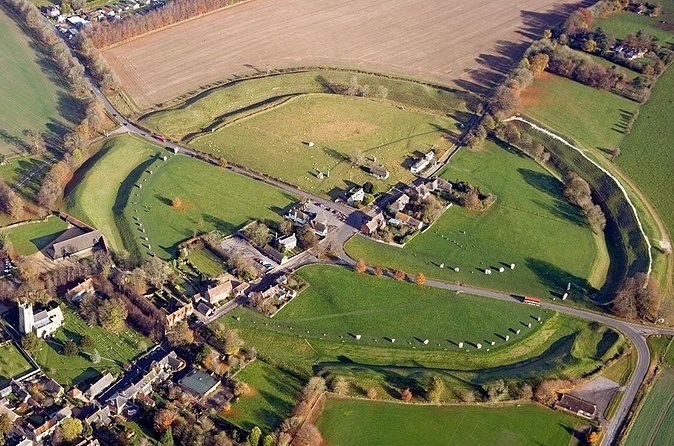
Not marginally. The Avebury henge encloses a circle about 347 metres in diameter, over a kilometre round, with a ditch cut some eleven metres into solid chalk and a bank that stood around nine metres above the old ground. Inside that stands an outer circle 331 metres across, which originally carried about a hundred sarsens, and inside that again two smaller circles of roughly a hundred metres each.
Stonehenge's entire stone setting would fit inside one of Avebury's inner circles. That is the fact that reorders most people's expectations, and it is the reason travellers keep writing that they had no idea. The full anatomy is on the stones of Avebury.
Why is Stonehenge so much more famous, then?
Because it is more legible. Stonehenge is one silhouette that photographs perfectly from one angle, and it has been the emblem of prehistoric Britain since the eighteenth century. Avebury does not resolve into an image: you cannot see the whole thing from anywhere inside it, and the aerial view that does make sense of it is not the one you get standing there.
Stonehenge is also worked. Its stones were shaped, squared and joined with mortice and tenon; Avebury's were raised broadly as they came off the downs. Craft photographs better than scale.
Which one should you visit if you only have time for one?
If the answer to "why are you going" is that you have always wanted to see Stonehenge, go to Stonehenge. Nothing at Avebury will substitute for that, and being told the other one is bigger will not help.
If the answer is that you want to stand inside something four and a half thousand years old and take your time about it, go to Avebury. It costs nothing, nobody hurries you, and the experience of walking between stones rather than past them is not available at the famous one on a normal ticket.
What about crowds?
Stonehenge is busy throughout its opening hours because everybody has a timed slot and the slots run all day. There is no quiet hour to find; there is only a less busy one.
Avebury's crowding is coach-shaped. The parties arrive between late morning and mid-afternoon and cluster around the pub, the café and the two quadrants nearest the car park. Before ten and after four the circle empties out, and because there is no opening time there is nothing to queue for. That is the single practical advantage of a monument with no gate.
Which is better with children?
Avebury, and it is not close. There is nothing to rope off, sheep graze the quadrants, the bank is a nine-metre earthwork you are allowed to walk along, and the whole thing is free if it goes wrong after twenty minutes. Stonehenge is a path, a rope and a shuttle bus.
The counterweight is the visitor centre, which is genuinely good and has the exhibition and the reconstructed Neolithic houses. If you want your children to be taught something, Stonehenge does that better. If you want them to feel something, Avebury does.
Can you do both in one day?
Yes, and most people should. They are seventeen miles apart, about half an hour by road, and almost every guided day pairs them for that reason. Doing both is the standard shape of a Wiltshire day out rather than an ambitious one.
The order matters if you are driving yourself: go to Stonehenge first, because its slot is fixed and its car park fills, then move north to Avebury, which has no slot to miss and improves as the light drops. The exception is the evening special-access departure, which reverses it because its Stonehenge slot falls at dusk.
How much does doing both actually cost?
Under your own steam, the Stonehenge ticket plus £8 for the Avebury car park. On a guided day, the fare, plus the Stonehenge admission on the eleven departures that exclude it. Three departures include it, and on those the day has no further ticket cost at all, because Avebury and West Kennet Long Barrow are both free.
That is the arithmetic nobody publishes, and it is why comparing fares alone misleads. The lowest headline price is not the lowest day. The full breakdown is on the visiting page and in the guide on how to choose an Avebury tour.
What is at Avebury that Stonehenge has not got?
- A village inside the monument, with a thatched pub in the ring.
- Two avenues of paired stones running out across the downs.
- Silbury Hill, the largest artificial mound in Europe, a mile away.
- West Kennet Long Barrow, a 3650 BC tomb you can walk into, free.
- Windmill Hill, older than the henge, a mile and a half north-west.
- No ticket, no slot and no closing time.
All of that is free, and all of it is within two miles. It is why the honest answer to "which should I visit" is often "Avebury, and give it longer than you planned" — the itinerary is set out in one day in the Avebury landscape.
And what has Stonehenge got that Avebury has not?
The image, the exhibition, and the shaped stones. The mortice-and-tenon joints, the lintel ring and the sheer engineering of the trilithons are things Avebury never attempted. If your interest is in what Neolithic builders could do rather than how much of the landscape they could organise, Stonehenge is the better site.
It also has the interpretation. Avebury has a small museum and almost nothing on the ground; nobody there will tell you that half the standing stones went back up in the 1930s unless you have a guide or have read it first.
Which is better for photographs?
Avebury, for one reason: you can move. At Stonehenge you shoot from a path at a fixed distance, in a composition several million people have already made. At Avebury you choose your angle, your foreground and your stone, and nobody moves you on because there is no closing time to enforce.
The western quadrant takes evening light and the eastern takes the morning. In December the sun sets before four, which means an afternoon visit and golden hour are the same thing. The trade is that Avebury does not resolve into one iconic frame, so what you come away with is a set rather than a shot — see the gallery for what that looks like.
What do the two cost, all in?
Doing both yourself: the Stonehenge ticket, bought ahead for the discount, plus £8 for the Avebury car park. That is the whole of it, because Avebury, West Kennet Long Barrow and Silbury Hill are all free.
On a guided day: the fare, plus the Stonehenge admission on the departures that exclude it. English Heritage members and National Trust England members enter Stonehenge free, which is worth checking before you pay for a tour that excludes the fee. Nothing at Avebury is ever payable, whichever way you arrive on an Avebury and Stonehenge tour.
Frequently asked questions
Which is bigger, Avebury or Stonehenge?
Is Avebury free and Stonehenge not?
Can you touch the stones at Avebury?
Can you visit both in one day?
The verdict, by traveller
First visit to England, one shot: Stonehenge, with Avebury on the same day if you can. Second visit, or a long stay: Avebury, with time. With young children: Avebury. With a serious interest in archaeology: both, and the Wiltshire Museum in Devizes as well. Photographers: Avebury, for the light and the freedom to move.
If you are coming from London without a car, the practical decision is which guided day to take rather than which monument to see, because almost all of them do both — Avebury Tours compares them, and getting there without a car covers the alternative.
Doing both? Three guided days include the Stonehenge admission, which removes the only ticket cost of the outing. They are marked in the Avebury tours comparison, and the practical detail on arrival is on the visiting page.
Days that give you both circles
Stonehenge and The Stone Circles of Avebury Day Trip from London
Both monuments plus a chambered tomb, with the Stonehenge ticket paid.
From $134 per person
Check AvailabilityStonehenge Special Access Guided Evening Tour from London
The only way to stand inside the Stonehenge circle, after hours.
From $213 per person
Check AvailabilityStonehenge, Avebury & the Cotswolds from Bath (Small group)
Both circles and two Cotswold villages, from Bath, at the lowest fare.
From $103 per person
Check Availability